In 2026, insurance repair estimates are increasingly coming in far below actual restoration costs, often 40–70% below what the cost of skilled labor and materials are. Understanding why this happens, and how to communicate it, is essential for property owners and contractors alike. But it is still increasingly frustrating.
In Western New York, homeowners filing property damage claims for water damage are increasingly discovering a significant divergence: the insurance repair estimates provided by their insurance company often fall well short of the bids received from local contractors. As a painting contractor with over sixteen years of experience working in homes rich in traditional plaster and lime finishes, We have observed this gap widen markedly since the beginning of the year.
Both drywall and plaster repair are being heavily discounted by insurance companies lately. The insurance supplied estimates for drywall repair, are averaging 50 – 70% below what they should be, and plaster as much as 90%. Case in point, a job in Snyder has 5 fairly large holes in a plaster home, in 5 different rooms. Smallest hole is 2′ x 3′. Insurance estimate claims all of these can be repaired for $350. That covers the materials…
When it comes to damage to your property, people often assume that their insurance company’s repair estimate represents the full honest cost of fixing damage incurred to their home. But in reality, the math that drives these estimates can diverge sharply from the real world costs associated with restoration work. This has become especially evident with plaster repair estimates.
The Limitations of Home Insurance Repair Estimates
in Real-World Projects
Why insurance repair estimates are low:
Most insurance repair estimates are generated using Xactimate, which relies on standardized unit pricing models, that calculates repair costs based on a simplified formula:
Cost = Area × Unit Price
This approach used to work well for production-driven repairs, like flooring, drywall, asphalt roofs etc.. The task is relatively linear: more square feet equals more labor and materials, and the total cost scales rationally and predictably. However as of late, it appears that insurance companies are intentionally limiting scope, or drastically under-valuing skilled trade labor and material costs in order to limit payouts for claims, often by a lot!
We see this often with ceiling repairs. A 12-square-foot plaster patch requires specialized skill and can take nearly as long or longer as a 40-square-foot drywall repair, depending on several factors:
- Substrate condition: Wood lath and Rock lath can be compromised beyond the visibly damaged area. Multiple layers of previous repairs, improper substrates such as drywall in place of plaster.
- Water damage complications: Moisture causes efflorescence, basically the water soluble salts in the plaster make their way to the surface of the plaster causing it to look corroded. Properly addressing it is key to preventing it from re-starting due to an improper repair.
Moisture can also cause plaster finish coats to peel from basecoat layers unpredictably and affect wood-lath and rock-lath differently. With water damaged drywall, often what you see, is what you get, most of the time. - Decorative Finishes: Different finishes, gypsum vs lime, smooth vs textured, often fail in uniquely different ways. There is no one size fits all when it comes to plaster repairs. Mixing finishes can create more problems such as failed repairs, or cracks.
- Texture replication: Achieving a seamless patch with existing plaster ceilings requires experience. Even flat ceilings have a texture. 50 years of painting creates a paint texture that can sometimes be difficult to match with todays coatings.
Sand swirl ceilings popular in homes from the 1960’s – 1990’s also present unique challenges which take time to replicate and is rarely seamless. - Curing and drying time: Plaster often needs days to dry before priming and painting. The thicker the repair, the longer it has to dry prior to painting. That means completely cleaning up the job, and leaving for a week or longer, then come back, set everything back up again to do the painting. With drywall repairs, this is generally a seamless transition between repair and painting.
In software applications, these factors are either ignored or grossly underestimated. The software may assume a “typical” plaster repair takes three hours, when in reality it can take 12–16 hours for a two-person crew to complete a small patch correctly. We recently seen this exact scenario play out.
Insurance Repair Estimate
vs
Contractor Estimate
Example #1: Plaster Ceiling Repair (Cheektowaga, NY)
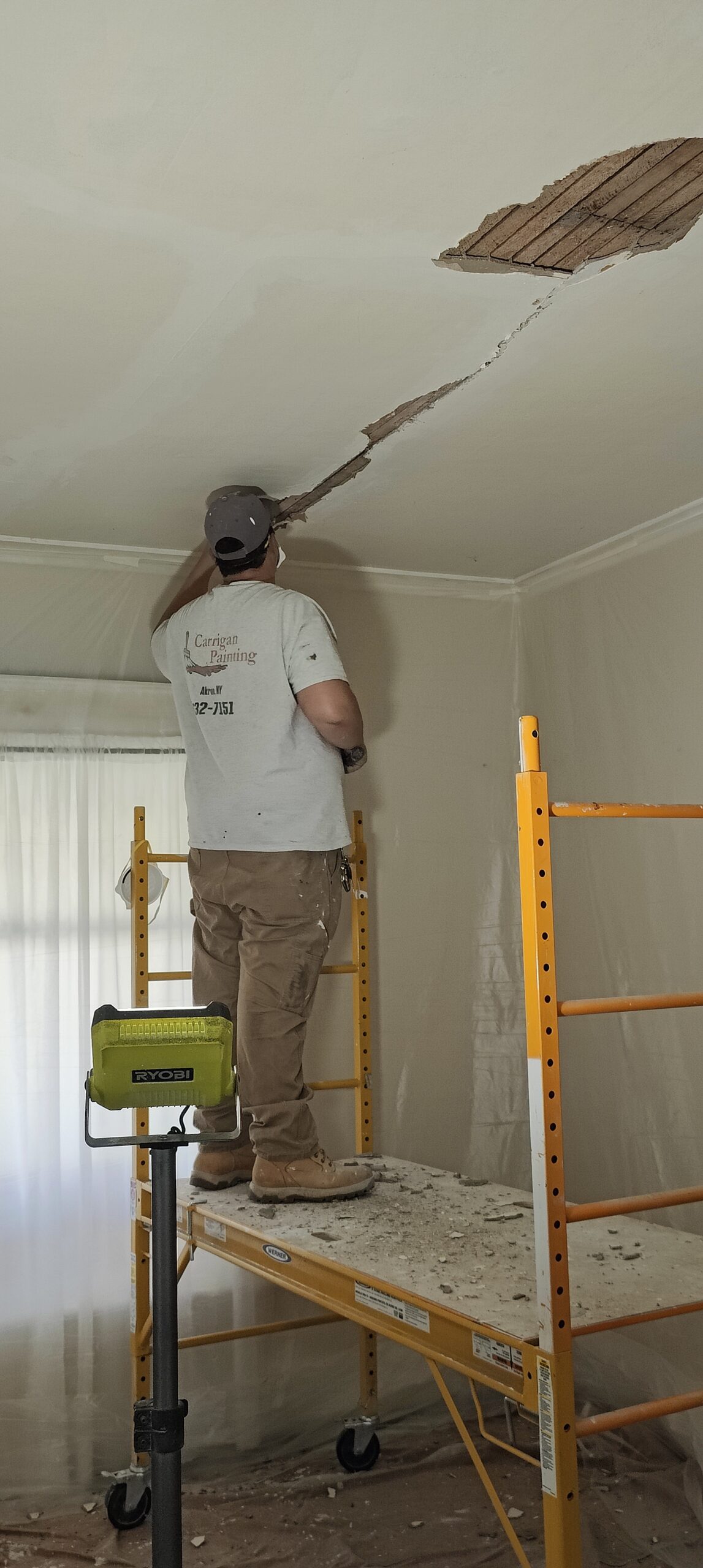
Earlier this year, I inspected a water-damaged plaster ceiling and wall in a living room in a 1940s Cheektowaga home. The damage included roughly 12–16 square feet on a ceiling and an adjoining foot or so, on the wall. The insurance company allocated $480 for plaster repair and $1,300 for painting of the room.
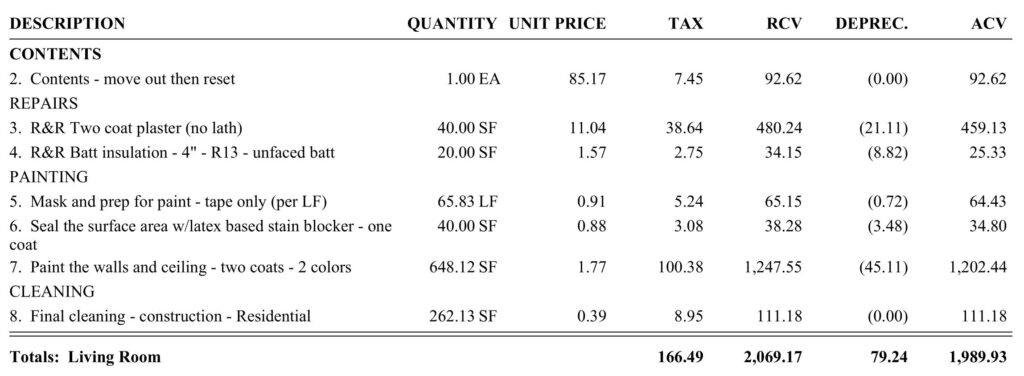
The actual repair required approximately 13 labor hours. The labor alone far exceeded the $480 allocated by insurance. In fact, the $480 plaster repair estimate equates to roughly three hours of labor time, which is not enough to even complete preparation and substrate assessment, let alone complete the repair.
After thoroughly explaining the nuances of the job to the insurance company, we were able to get them to realize that the amount they initially estimated was way too low. This isn’t unique to this job, we are increasingly seeing insurance repair estimates come in low and require extensive clarification and adjustment, this process is time consuming. In this instance, we spent an additional 3 hours on the administrative side explaining to the insurance adjuster what this job entailed.
Example #2: Drywall Ceiling Repair with Trim (Clarence, NY)
In another example, a home in Clarence NY had a plumbing issue that affected the living room ceiling, this is more common than people think. The mold remediation people removed 1/2 of a 20′ x 16′ drywall ceiling, including the ornate crown molding. The insurance company, claims that the room can be restored to its pre-damage condition for $1,800.
To repair this damage will require some minor framing, installation of 4 sheets of drywall, installation of about 30′ of crown, patching the ceiling, sanding, priming the patch, then apply two coats of paint to the ceiling, walls, and trim. Then do a full cleanup – for $1,800 including materials and tax.
This project is closer to $6,000, and will take approximately 4 days to complete with over $600 in materials and three different trades. Based on the insurance repair estimate, the total budget for this project is about $1600. Minus materials leaves about $1,000 for labor of highly skilled work. Using the insurance provided numbers, they expect the homeowner to find a reputable, legally compliant contractor to work on their house for four days for $30 an hour. When you take out insurance, taxes, and other overhead costs incurred by contractors, its mathematically impossible to do the job.
Example #3: Plaster Wall and Swirl Ceiling Repair (Williamsville, NY)
Our 3rd example, involves substantial water damage from an ice dam. In this case, the remediation people removed over 1/2 of a rocklath plaster wall, and a large portion of a swirled plaster ceiling. The homeowner has lived in this home for 70 years, since it was built in the 1950’s and did not want a drywall patch. Pictured below, is the insurance repair estimate for this project, which is 90% below the actual cost of restoration. $450 vs $5,500.
Also, the insurance company initially quoted painting only HALF of the ceiling! Who paints only half of a ceiling?
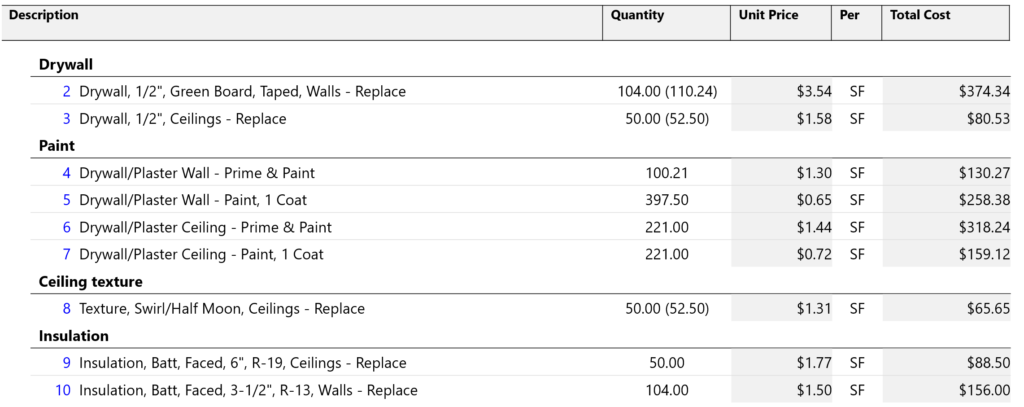
The painting scope of this estimate also grossly undervalues the true cost of professional painters. No self respecting painter doing high-end work is working for $0.65 a square foot, which according to this, includes materials!
The Gap Exists
to Protect Profits
There are four main reasons for the disparity between insurance estimates and real-world costs:
- Linear vs. Nonlinear Work
Software assumes all work scales linearly with area. Plaster restoration does not. The process-driven nature of restoration, introduces delays that inflate labor far beyond what a square-foot calculation predicts. - Limited Database Knowledge
Estimating software is built for common repair scenarios, always based on drywall. It does not account for the complexity of traditional multi-layer systems, or the variability introduced by older plaster homes which requires specialized skills to repair correctly. - Market Scarcity of Skilled Labor
In Western New York, very few contractors still repair traditional plaster correctly. The two large plaster companies focus on commercial or historical restoration and avoid small residential repairs. This scarcity drives labor rates above the assumptions baked into insurance databases. - Profit Margins
Residential insurance repair estimates consistently come in below real-world costs for specialized repair-work. Whether that’s driven by profit targets or outdated pricing models, the result is the same: property owners are often left underfunded for proper repairs. And contractors are often left burning through profits arguing with insurance companies over their unrealistic expectations.- LendingTree’s recent data shows that homeowners insurance premiums have risen sharply in recent years, with costs climbing 40% over the last six years and big increases in both 2023 and 2024. The last 5 years were not a smooth “high profit” period, they were more like three bad years, one very bad year, and then a return to profitability in 2024. That means many insurers were relying on rate hikes to offset underwriting weakness.
That trend helps explain why insurers are trying to control claim costs and keep estimates low. When a repair involves traditional plaster, underestimating the job can protect the carrier’s bottom line while leaving the property owner short on the funds needed to restore the home properly.
Administrative Burden
on Contractors
One of the most significant emerging challenges in insurance-related restoration work is the substantial increase in unpaid administrative time required to reconcile insurance repair estimates.
As a local painting company in Western New York, we typically do X bids per week while actively working on jobsites. Preparing accurate, detailed bids for these jobs already demands considerable time and effort. In the past, insurance claims followed a relatively streamlined process. Today, the procedure has become far more time-intensive.
We still offer free quotes for work, but the time investment requirements by insurance companies has become a problem.
After submitting a comprehensive bid supported by detailed scope descriptions, it is now common to receive a list of questions from the insurance adjuster one to two weeks later. Responding thoroughly, often includes addressing substrate conditions, efflorescence management, or curing requirements, often consumes 1 – 2 hours or more per exchange. When responses prompt further rounds of clarification, or when a significantly lower revised insurance estimate arrives weeks or a month later, additional site revisits become necessary.
This administrative overhead, which generates no direct revenue, has become a substantial time investment in insurance-driven restoration projects. I can see why the cumulative burden leads some contractors to consider declining insurance work altogether, despite the clear need among homeowners for restoration services.
Meanwhile the homeowner is left living with a giant hole in their ceiling. In years past, the average bid from meeting with the perspective client to writing the estimate took 1 – 2 hours. So far in 2026, when insurance is involved, we are looking at a 4-6 hour process over 2-6 weeks.
Conclusion
Insurance repair estimates are a starting point, not a final or accurate reflection of real-world repair costs. Database-driven pricing works for standardized, production-based work, but it consistently undervalues specialized trades like traditional plaster repair, drywall repairs, ceiling repairs and texture replication.
For property owners, the takeaway is simple: a low insurance repair estimate does not define the true cost of proper restoration. There is wiggle room here.
For contractors, success comes from clearly documenting scope, process, and time requirements to bridge the gap between estimate and execution.
Insurance companies typically calculate payouts using ACV (Actual Cash Value), the depreciated value of the damaged materials, and RCV (Replacement Cost Value), which reflects the full cost to replace them. In many cases, an initial payment is issued upfront, with the remaining balance released only after the work is completed and documented.
At Carrigan Painting, we thoroughly document our projects.