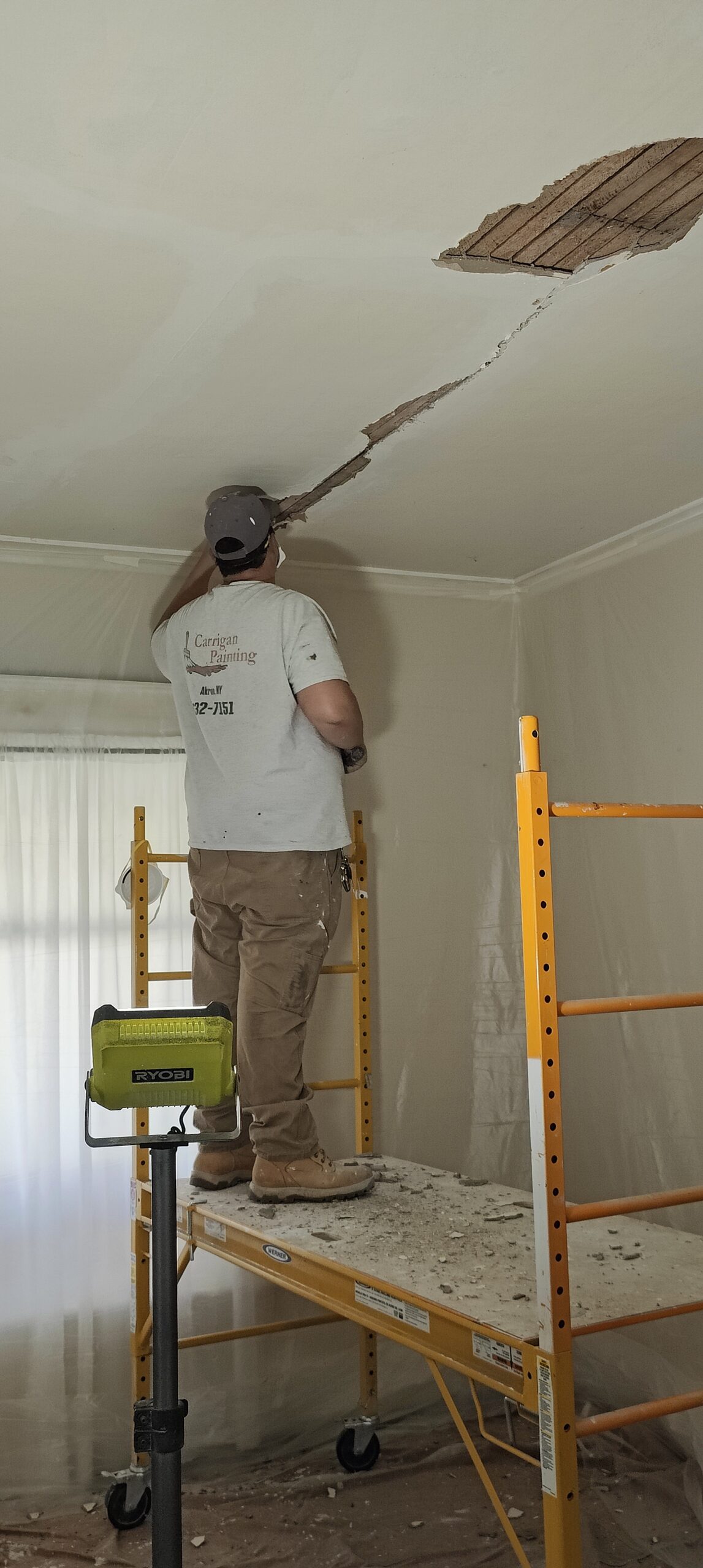
There is an emerging problem with plaster ceilings developing that is just beginning to take shape, and we feel it could eventually affect all painted plaster ceilings, specifically. And that is the weight of the paint on the existing ceiling causing the first coat of paint on that 80 year old ceiling to lose adhesion to the glass-like finish of the plaster.
It might look like water damage, but if there is no plumbing above, and no roof near by, and the ceiling didn’t previously have popcorn texture.. this could be the cause of your peeling paint on your plaster ceiling..
At first it appears to be a small bump, about the size of a pimple on an otherwise pefectly smooth ceiling, over time, pesky gravity pulls it down more causing tension on the surrounding paint until it cracks and creates a small blister. Now, will it continue to peel? Maybe. Maybe not..But once it starts, we are unaware of a single product currently on the market that will stop it, simply because accessing the original surface is impossible.

Whatever you put over it, has to rely on the first coat of paint, to not lose adhesion, when it now has a history of showing it is losing adhesion. Quite the predicament… and it gets worse. The more times you paint a plaster ceiling, the worse the problem gets. Now add patching material, or worse, you skim coat the ceiling. Drywall compound and 2 coats of paint is arguably heavier than 2 coats of paint. Which in an effort to fix the ceiling, inevitably makes the problem worse. Current options are limited and expensive.
Suffice to say, the more times you paint a plaster ceiling, the more weight you add to an 80+ year old coat of paint (the first coat) and are relying solely on it’s adhesion. In our experience, plaster homes are painted about once every 10 years, so that is 8-12 coats of paint relying on the first coat of paint to not peel.
Option 1: Remove the plaster ceiling and install a new one. Depending on room size this can be cost prohibitive. Plus, if the original plaster ceiling is structurely sound, and in otherwise good shape, going over the existing plaster ceiling with drywall is an option. You will not notice a 1/2″ lower ceiling height. You won’t. But this also means you will be repainting the walls, as the corners where the ceiling meets the walls must be finished. This will impact the walls as well.
Option 2: Going over the plaster ceiling with drywall presents more difficult installation, driving drywall screws into plaster, overhead.. not fun. Also, any repairs to the ceiling are a concern, escpecially if the history of any patches is unknown. And a lot of people, can not spot a giant plaster bulge in a plaster ceiling. You do not want to drywall over a plaster ceiling that isn’t attached to anything, or has itself begun to drop. Drywall screws alone will not hold a ceiling that can weigh in excess of 4,000lbs. The plaster will simply drop around each screw. So having the ceiling professionally evaluated prior to going this route, is very strongly advisable.
Many people wrongly assume 1/4″ drywall is the way to go in many of these situations. It is not. 1/4″ drywall lacks the physical mass to not sag between fasteners. Over time, this can create a pillowing effect such as what is seen with some rocklath plaster ceilings. This often creates new expensive headaches for the homeowner.
Options 3: Sanding off the paint. This is a very labor intensive option which can create or execerabate other problems. Power sanding a plaster ceiling can cause vibrations which can loosen nails holding the ceiling in place, cause cracks to get bigger, and if the ceiling isn’t stable to begin will, cause a partial collapse. And we haven’t even addressed the airborne particulates created by the sanding which is detrimental to the health of everyone involved. This option should not even be considered due to the health risks involved.
Because we primarily work with ceilings we have some ideas about how to potentially delay the inevitable until a solution is found, but that is propriatary information and still under development.
Project Details – Attributes are links to related projects.
| Category | Failure Analysis |
|---|---|
| Type of Damage | Peeling Paint |
| Source of Damage | Age |
| Substrate | Rock-Lath Plaster, Wood-Lath Plaster |
| Secondary Category | Failure analysis |
| Images | 1 |
Show more project detailsShow fewer project details
| Videos | 0 |
|---|