Who Should You Call First
After Water Damage in Your Home?
One of the most common problems we face following residential water damage has nothing to do with drywall, plaster, or paint. Homeowners often simply do not know who they should call first.
Should you call a painter? A drywall contractor? A plumber? Your insurance company? A water mitigation company? A mold remediation contractor?
The answer depends on what caused the damage, whether the source of the water has been stopped, how long the affected materials remained wet, and whether mold or microbial growth is suspected.
Carrigan Painting is often one of the first companies homeowners call because the visible damage appears to be a damaged ceiling or wall. We repair plaster and drywall, restore damaged ceilings, and paint the completed repairs. But in many water-damage situations, we are not Step One.
In fact, when mold is suspected or specifically identified, a painting contractor is the wrong first call.
The Four Stages of Water Damage Repair
The Basic Order
of Water-Damage Repairs
For most residential water-damage projects, the work generally follows four distinct stages:
Step One: Stop the source, assess the damage.
Before cosmetic repairs can begin, the source of the water must be identified and stopped. Depending on the situation, this may involve a roofer, plumber, or a water-mitigation company. If you have water leaking from a ceiling, grab a bucket, or a pot, and poke a hole in the ceiling right where the water is dripping from.
Your screwdriver should easily penetrate the saturated surface. Be prepared for a lot of water to come out of that small hole. A broom handle will work too. Do not puncture a ceiling near electrical fixtures, wiring, or other electrical components, and do not stand directly beneath a badly sagging ceiling.

If it’s a roof leak, your ability to stop the inflow of water will be limited, so the next best course of action, is trying to control where that water goes. Remember; Mother Nature will always take the most expensive path. If you have water coming through your walls.. move to higher ground.
To help narrow down the source of the leak, temporarily turn off the water in the home, and open the highest faucet. If the water slows or stops after shutting off the home’s water supply, you may have a plumbing leak. If it continues, the source may be elsewhere, but remember, water already trapped inside a ceiling or wall can continue draining for some time.. Poke a hole in the ceiling first – small hole.
Step Two: Complete any necessary mitigation or remediation.
Local companies that advertise water remediation as a primary service include ServPro, or Paul Davis.
Wet insulation should be removed, concealed cavities opened, materials dried, and suspected mold addressed, that work is done before drywall, or plaster repairs and painting begin. Drying often involves industrial-style fans, special air cleaners, and other expensive, specialized tools and equipment that the majority of contractors do not have. Some of these air cleaners start at $500.. plus $50 per filter..
It’s expensive to get into remediation and to do it correctly so no one in the home gets sick. If done improperly, opening contaminated cavities and moving large volumes of air will spread mold spores and contaminated dust into previously unaffected areas of the home, making your home uninhabitable. We have worked inside the aftermath of failed mold remediation. We have seen what happens when this is done wrong. Do not treat it casually.
It’s important to get this part right.
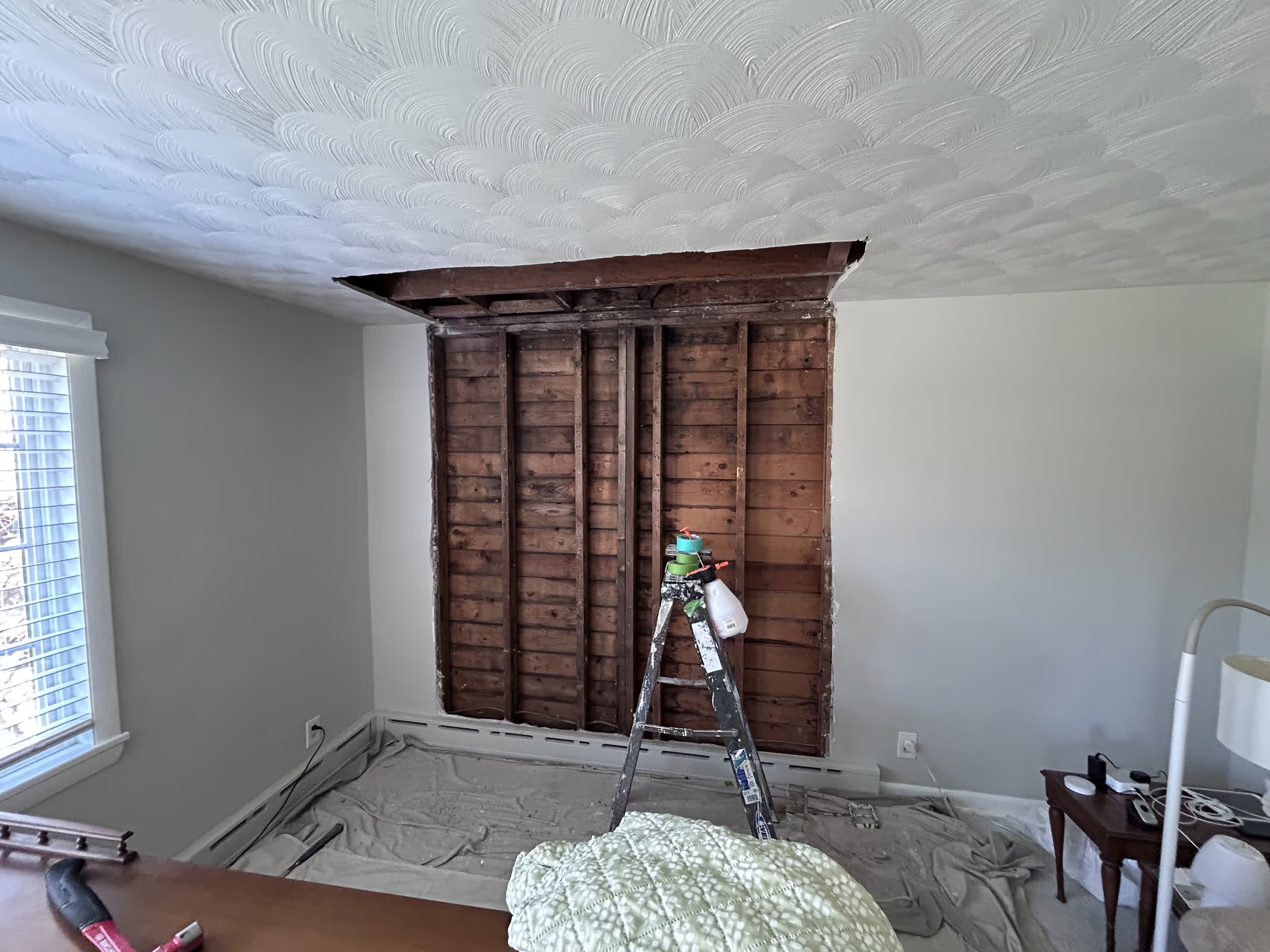
Step Three: Repair the damaged walls and ceilings.
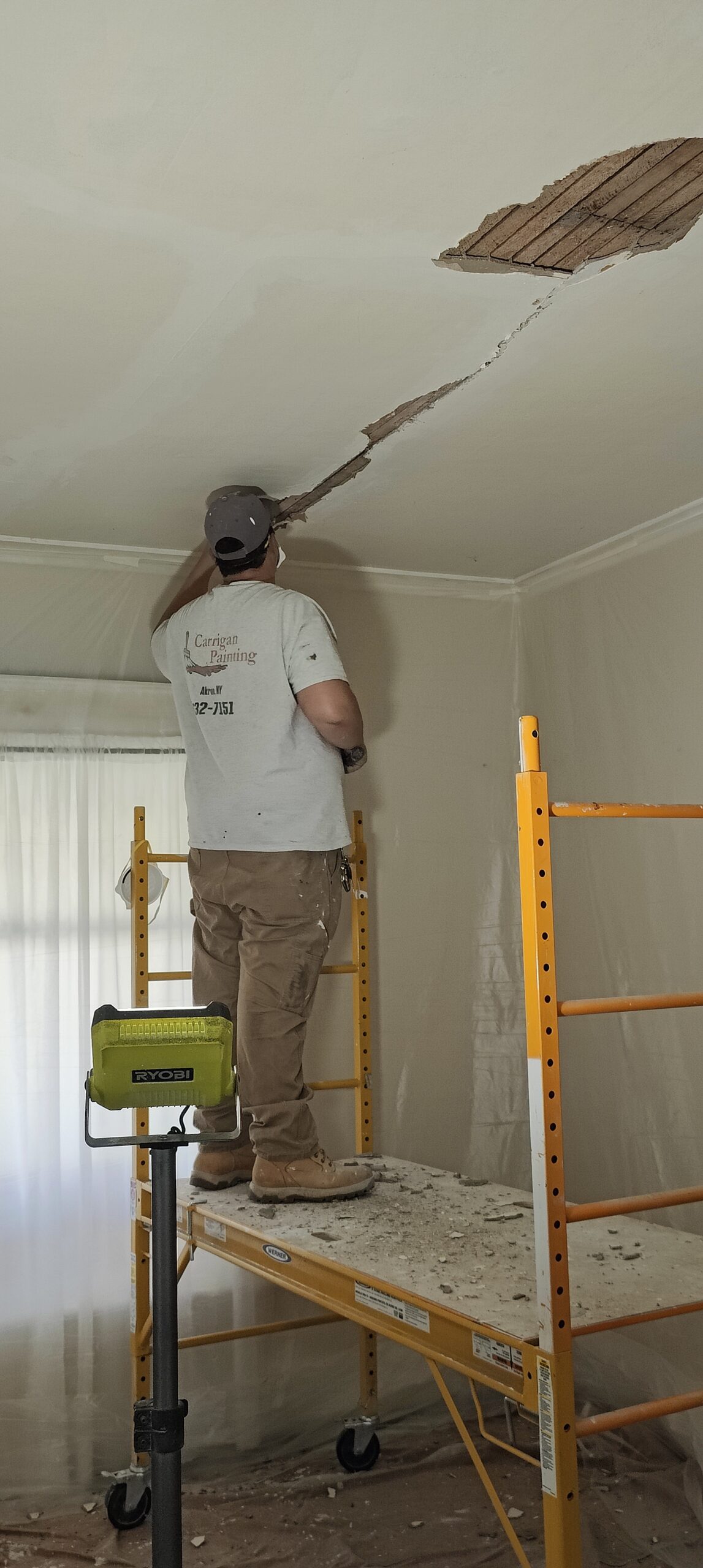
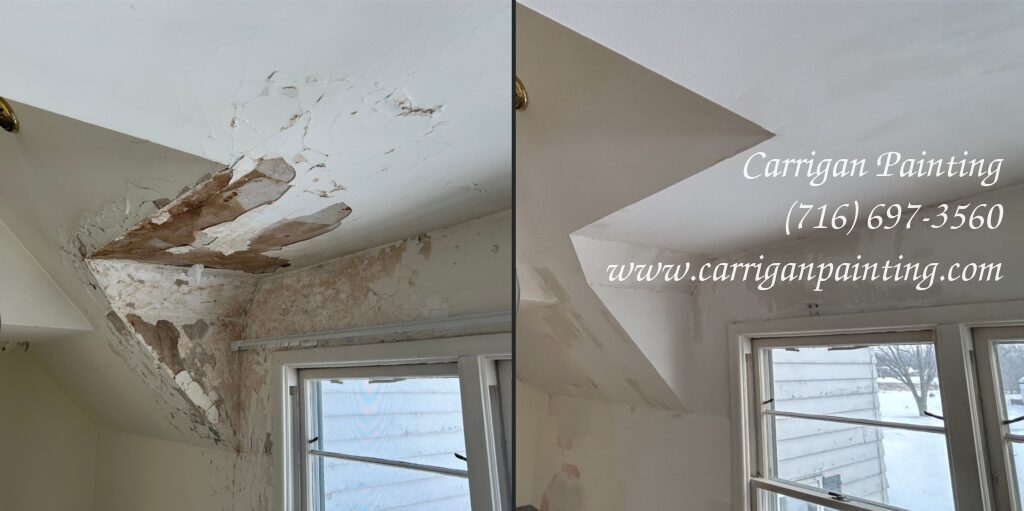
Once the affected area has been properly addressed, damaged drywall and plaster, and other building materials can be repaired or replaced as needed. This is where Carrigan Painting often becomes involved. We perform residential plaster repair, drywall repair, and ceiling restoration throughout the Buffalo suburbs. We are step three.
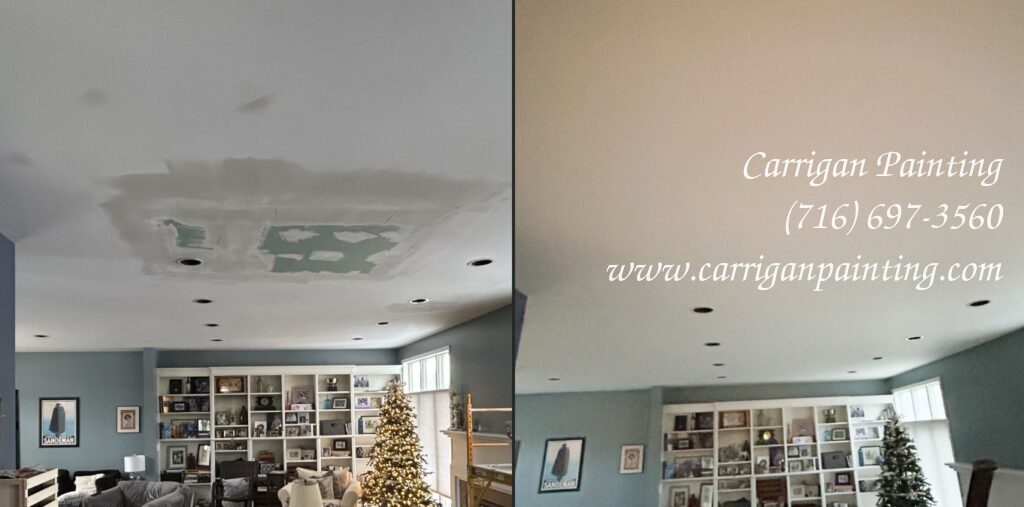
Step Four: Prime and paint the repairs.
After repairs of the walls and ceilings are finished, the affected surfaces can be primed and painted. We include priming in all of our repair-work as standard company policy. Our goal with our repairs is to leave the client a structurally sound surface they can decorate however they wish without worrying about if they should prime the repairs first or not.
Carrigan Painting performs both the repair and painting stages of many water-damage projects, which allows the homeowner to use one company for Steps Three and Four. Realistically, you do not want a “One call does it all” type of contractor for ceiling repair work. While it may look like just a simple ceiling patch, you get one chance to do it right.
Water damage can involve roofing, plumbing, insulation, drying, mold remediation, drywall, plaster and painting. Those are different trades with different equipment, training, skillsets, and insurance requirements. A company willing to do all of them does not necessarily mean they are equally qualified to do all of them.
Why We Often Tell Homeowners
to Call Someone Else First
A recent consultation involved a condominium in East Amherst, affected by a significant ice-dam leak. The preliminary scope done by the HOA, called for portions of multiple ceilings and walls to be removed, insulation to be removed and replaced, several additional ceiling areas to be opened, and remediation work to be performed. Looking at the job, we can’t tell if mold is involved, and the HOA, which is paying for the repairs, wants to ensure there is no danger of mold- understandable.
That means, the mold people need to be brought in first. See Step Two.
The visible damage involved water stains, and some cracks on the ceilings and walls. The homeowner described a waterfall of water pouring out of her kitchen ceiling. I advised that in the future, to poke a small hole in the ceiling that is actively leaking water, and to let the water out. This can prevent a ceiling collapse.
Because mold had already become part of the conversation, our recommendation was to begin with a company specifically equipped and insured for water mitigation and mold-related work. Only after that stage is completed should the project move into repair and painting.
Many painting contractors repair drywall. Some advertise mold-related services. But performing painting and drywall repairs does not automatically mean a contractor is properly insured, trained, or equipped for mold remediation. It’s imperative that the company that does the remediation, is equipped to handle these scenarios. It’s not as simple as tearing open walls and ceilings and setting up a couple of fans and calling it “remediated”.
Carrigan Painting does not offer any mold remediation.
A Damaged Ceiling
Does Not Always Mean “Call a Painter”
Water damage is often a sequence of problems rather than a single event.
The leak must be stopped first. Wet materials may need to be removed. Walls and ceilings may need to be opened. Insulation may need to be replaced. The framing may need time and special equipment to dry. Mold requires specialized training, and equipment to safely remediate.
Only then can repairs begin.
If you call Carrigan Painting first, we can evaluate the visible wall and ceiling damage and explain where our work fits into the repair puzzle. In many cases, we are able to proceed with the repair. In others, we may tell you that another contractor needs to come before us.